[TEMP CHECK] Babylon Trustless BTC Vault Integration on Aave V4

Asset Info
CreatorN/A
Registration TimeLoading...
Registrar[TEMP CHECK] Babylon Trustless BTC Vault Integration on Aave V4
Capture TimeLoading...
GeolocationN/A
File TypePNG
Source TypedigitalUpload
Details
Abstract
Author: Babylon Labs
Date: 25-5-26
Simple Summary
This Temperature Check seeks community input on the deployment of two new Aave V4 Spokes (Babylon Core Lending Spoke and BTC Vault Swap Spoke) to onboard native BTC as collateral, via the Trustless Bitcoin Vaults protocol. In TBV, a depositor locks BTC in a Taproot UTXO on Bitcoin. Redemption is governed by on-chain rules (e.g., the depositor repaid their loan) and settles directly to a Bitcoin UTXO controlled by the redeeming party. No wrapping, no bridging, no custodians.
Background
Babylon
Babylon was started in 2022 by Professor David Tse (Stanford) and Dr. Fisher Yu, with a vision of a Bitcoin-backed crypto economy built on trustless protocols that unlock Bitcoin’s productivity without bridges, wrappers, or custodians.
The project is best known for its trustless Bitcoin staking protocol, which lets BTC holders stake their BTC to secure other chains and rollups and earn staking rewards. The protocol is fully self-custodial: BTC never leaves Bitcoin and is not held by a bridge, wrapper, or signer set. Since launch in August 2024, the protocol has activated over 100,000 BTC cumulatively, reached a peak TVL of 72,000 BTC, and currently holds ~51,000 BTC (approximately $4B) staked.
The success of Bitcoin staking demonstrated that BTC holders seek trustless and native ways to put their Bitcoin to work. This motivated the development of Trustless Bitcoin Vaults (TBV), which extends the same trustless and self-custodial principles to general DeFi participation, and is the subject of this proposal.
Babylon developments are backed by approximately $100M+ to date from a16z, Paradigm, Polychain, Hack VC and others.
Trustless Bitcoin Vaults (TBV)
Trustless Bitcoin Vaults (TBV) allows anyone to use their native Bitcoin as collateral in supported on-chain applications, without transferring custody to any trusted third party.
TBV achieves this by locking BTC on Bitcoin inside a Taproot script. The conditions under which it can be moved are enforced cryptographically: redemption requires a valid zero-knowledge proof of an event on host chain (e.g. Ethereum Mainnet), and any attempt to claim BTC without a valid proof can be challenged and stopped by an eligible challenger during a fraud-proof window. The depositor is always eligible to act as a challenger themselves, so they need not trust any third party to secure their BTC.
The protocol introduces no third-party custodian, signer consortium, or threshold-signature group with discretionary control over the underlying BTC. Spending conditions are encoded in the Taproot script and governed by zero-knowledge proof verification through a challenge-based procedure redemption is native to Bitcoin. The locked BTC moves to a recipient designated by the vault’s spending conditions, which reference events on the host chain.
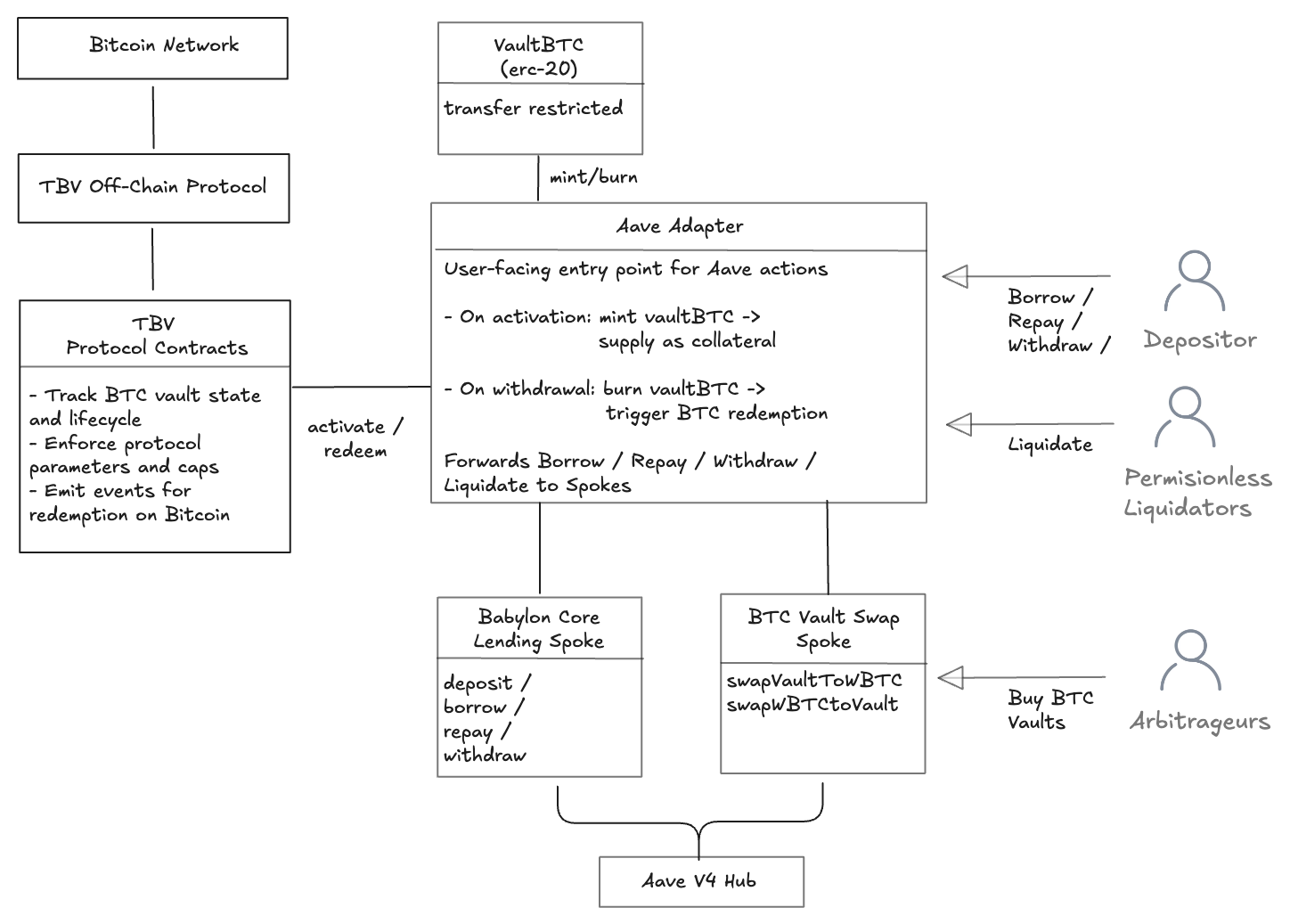
TBV can be integrated with any application on any supported host chain. When BTC is locked in a Taproot script, a corresponding BTC vault record is created on the host chain (e.g. Ethereum). Each application integration builds on the BTC vault record, optionally via an adapter layer that exposes it through the application’s interface. For the Aave V4 integration, since Aave V4 only accepts ERC-20 tokens as collateral, the adapter contracts represent BTC vault records 1:1 as a transfer-restricted ERC-20 token called vaultBTC. The full component set is detailed in Specification.
TBV is built on BaBe (eprint 2026/065), peer-reviewed cryptographic research (to appear in CCS 2026, the top security conference) developed jointly by Babylon Labs and UC Berkeley. BaBe makes SNARK proof verification on Bitcoin approximately 1000x cheaper than prior approaches, making trustless Bitcoin DeFi practical at scale.
Why Aave V4
Aave V4’s Hub-and-Spoke architecture provides an isolated environment in which integrations can deploy both standard and custom Spokes without affecting other assets on the Hub. This is what makes V4 the right venue for the integration.
Two Spokes will be deployed: a lending Spoke (Babylon Core Lending Spoke) in which allowed loan assets are borrowed against native BTC collateral, and a custom BTC Vault Swap Spoke built to swap seized BTC collateral to WBTC and support permissionless liquidations. Both are detailed in Specification.
Aave DAO retains full control over all parameters and caps on both Spokes. V4’s programmability is what makes this kind of integration possible while preserving that governance oversight.
Motivation
The Aave V4 integration with Babylon Trustless Bitcoin Vaults protocol enables onboarding of non-custodial native BTC collateral on Aave. Depositors can borrow allowed loan assets against this collateral, with no third-party custodian, signer consortium, or threshold-signature group holding the underlying BTC.
The BTC Vault Swap Spoke ensures liquidation on Aave remains permissionless despite the underlying collateral settling natively on Bitcoin. Any liquidator can settle the position by receiving WBTC for a small premium, while arbitrageurs purchase the escrowed vaults and handle the BTC-side redemption. This adds borrowing demand for WBTC on Aave, the largest BTC reserve on the platform (~$5B supplied) and presently underutilized on the borrow side. Mechanism described in Specification.
Native BTC as collateral on Aave V4 also serves as a composable primitive for the broader BTC DeFi ecosystem. Other projects can build new BTC-collateralized products on top, extending Aave’s reach into BTC-native DeFi.
Specification
This Temp Check is scoped to integration architecture. Risk parameters, oracle configuration, supply and borrow caps, interest rate strategy, and full trust-assumption and challenger-economics details will be presented in the follow-up ARFC. Audits are being performed by Coinspect, Sherlock, Zellic, ABDK, and ZK Security across the protocol stack, with formal verification by Runtime Verification ongoing. The integration deploys new Spokes and adapter contracts only. Adapter contracts are user-facing entry points that integrate BTC vaults on Ethereum into Aave V4 Spokes. The Babylon Core Lending Spoke uses Aave V4’s standard open-source Spoke implementation; while the Bitcoin Vault Swap Spoke introduces custom Spoke code.
The integration introduces two new Spokes on Aave V4 (Ethereum Mainnet) and one new collateral asset listed inside them:
1. Babylon Core Lending Spoke
The lending Spoke. Use Aave V4’s standard open-source Spoke implementation, with vaultBTC as the sole collateral asset and supported borrowable assets (stablecoins, wrapped BTC …) drawn from an Aave V4 Hub.
A depositor locks BTC on Bitcoin; the corresponding BTC vault record on the host chain is translated into vaultBTC and supplied as collateral on the Spoke through adapter contracts. The same adapter contracts give depositors all standard position-management actions: adding collateral by providing additional BTC vaults, withdrawing one or more BTC vaults from a position, borrowing and repaying. Permissionless partial liquidations are also supported.
2. vaultBTC
vaultBTC is an internal accounting unit required to integrate with Aave V4’s ERC-20 collateral interface, not a tradable or transferable BTC wrapper. It is a transfer-restricted ERC-20 whose destinations are limited to a fixed allowlist: the Aave V4 Hub, the Babylon Core Spoke, and the integration’s adapter contract. Transfers to any other address are not allowed.
Mint and burn are restricted to the adapter contract. vaultBTC is minted only when a BTC vault is added to a user’s position as collateral, and burned only when a BTC vault is withdrawn from a position. No other mint or burn path exists. Total supply always equals the BTC locked in active positions.
3. BTC Vault Swap Spoke
A custom Spoke for post-liquidation BTC collateral settlement.
When a position is liquidated by a permissionless liquidator, the liquidator swaps the acquired BTC vaults for WBTC through this Spoke at a small premium, with the WBTC drawn from an Aave V4 Hub and held as debt against the BTC vaults. Arbitrageurs, a permissioned set with redemption rights, later buy individual escrowed BTC vaults by repaying the WBTC debt (principal plus accrued interest) and redeem the BTC on Bitcoin.
The Spoke exists because BTC redemption is restricted to pre-committed actors in each BTC vault’s Taproot script and takes multiple days through the fraud-proof challenge window. Decoupling liquidation timing from BTC redemption lets permissionless liquidators settle in WBTC immediately while arbitrageurs handle redemption on Bitcoin’s timeline.
The only direct fund-flow touchpoint between the Hub and the BTC Vault Swap Spoke is the WBTC drawn at liquidation, which is repaid when arbitrageurs purchase the escrowed BTC vault.
Disclaimer
Babylon Labs is the author of this proposal. We have not been compensated by any third party to publish it.
This TEMP CHECK has been prepared solely to facilitate community discussion.
Next Steps
Temperature Check: Gather community feedback and assess sentiment towards the deployment of two new Aave V4 Spokes (Babylon Core Lending Spoke and BTC Vault Swap Spoke) and the listing of vaultBTC as collateral to onboard native BTC as collateral via the Babylon Trustless Bitcoin Vaults (TBV) protocol. The vaultBTC listing would be added either to an existing V4 Hub or to a new Hub deployed for this integration.
ARFC: If the Temperature Check Snapshot indicates positive sentiment, proceed to the ARFC stage for further discussion, risk parameter evaluation, audit review, and finalization of the proposal.
AIP: If the ARFC stage Snapshot is successful, submit the proposal as an AIP for voting and on-chain governance approval.
Copyright
Copyright and related rights waived via CC0.
1 post - 1 participant
Read full topic
LicenseN/A
Used Bygovernance.aave.com...
Mining PreferenceN/A
Integrity Proof